Bloklab Blog
AI Agents: The Next Layer of Digital Infrastructure
Published on 3/16/2026
AI agents represent the next evolution of artificial intelligence—autonomous systems capable of planning, reasoning, and executing complex tasks across digital environments. As organizations adopt agent-based workflows, these systems are reshaping software, automation, and the future of work.
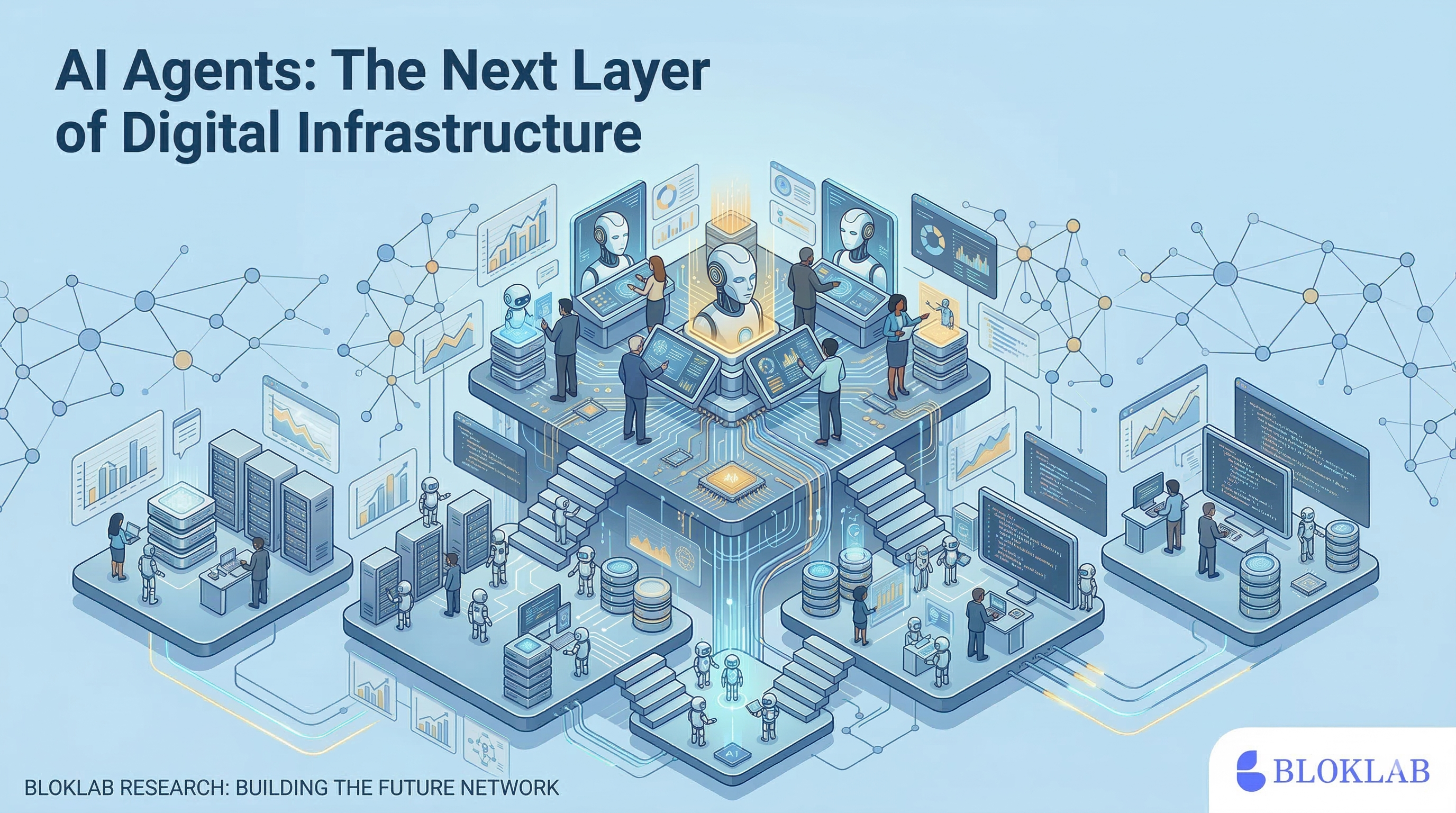
AI Agents: The Next Layer of Digital Infrastructure
How Autonomous Systems Are Transforming Software, Workflows, and Entire Industries
Artificial intelligence has evolved rapidly over the past decade. Early systems focused on narrow tasks such as image recognition, translation, or recommendation algorithms. More recently, large language models and generative AI have introduced new ways of interacting with software through natural language.
However, a new paradigm is emerging that goes beyond chat interfaces and single-step automation: AI agents. These systems are designed to perceive, reason, plan, and act autonomously in digital environments. Rather than simply answering questions, AI agents can execute tasks, coordinate workflows, interact with tools, and make decisions within defined constraints.
As organizations search for ways to automate increasingly complex processes, AI agents are becoming one of the most important technological developments shaping the next phase of digital transformation.
What Are AI Agents?
An AI agent is a software system capable of independently performing tasks on behalf of a user or organization. Unlike traditional software scripts or rule-based automation tools, AI agents combine several capabilities:
Natural language understanding
Contextual reasoning
Goal-driven planning
Interaction with APIs and software tools
Continuous learning or adaptation
In practice, an AI agent functions more like a digital operator than a static program. It receives an objective, breaks it down into smaller tasks, determines what information it needs, and executes actions across different systems to achieve the desired outcome.
For example, instead of asking an AI model a question such as “What are the best flights to Helsinki?”, a user might instruct an AI agent:
“Plan my business trip to Helsinki next week, optimize for price and travel time, book the flights, and add the itinerary to my calendar.”
The agent would then:
Search flight databases
Compare prices and travel durations
Select the optimal option
Complete the booking
Update the user’s schedule
This shift—from answering queries to executing goals—is what distinguishes AI agents from earlier forms of AI.
Core Components of AI Agent Systems
Although implementations vary, most modern AI agent architectures include several key components.
1. Goal Definition
Every agent operates around a defined objective. The goal may be simple (summarize documents) or complex (optimize logistics operations across multiple supply chains).
Goals often include constraints such as:
budget limits
time requirements
risk tolerance
compliance rules
These constraints guide the agent’s decision-making process.
2. Reasoning and Planning
Once an objective is defined, the agent must determine how to accomplish it. This usually involves decomposing the goal into smaller steps.
For example:
Goal: Launch a marketing campaign
Subtasks might include:
market research
competitor analysis
content creation
advertising budget allocation
campaign deployment
Modern agents rely on language models or planning algorithms to generate structured task sequences.
3. Tool Use
Agents rarely operate in isolation. Instead, they interact with external systems such as:
APIs
databases
spreadsheets
CRM platforms
payment systems
analytics tools
Tool use is what allows AI agents to move beyond theoretical reasoning and actually change the state of digital systems.
4. Memory Systems
Longer-running tasks require agents to remember previous steps, results, and contextual information.
Two forms of memory are common:
Short-term memory: context relevant to the current task.
Long-term memory: stored knowledge that improves future performance.
Effective memory architecture is essential for building agents that can handle complex workflows.
5. Feedback and Iteration
Many AI agents operate through iterative loops:
Plan an action
Execute the action
Observe the result
Adjust the strategy
This feedback cycle allows agents to correct errors and improve outcomes over time.
Emerging AI Agent Architectures
Several architectural patterns are currently shaping how AI agents are designed.
Single-Agent Systems
A single autonomous system performs all tasks required to achieve a goal.
Advantages:
simpler infrastructure
easier monitoring
faster execution
However, single-agent systems may struggle with highly complex or multi-domain tasks.
Multi-Agent Systems
In this model, multiple specialized agents collaborate to complete a task.
Example:
A startup-building system might include:
a research agent
a financial planning agent
a product development agent
a marketing agent
Each agent focuses on its domain while coordinating with the others.
This approach mirrors how human organizations operate.
Human-in-the-Loop Agents
In many real-world environments, fully autonomous decision-making is not desirable.
Human-in-the-loop systems allow people to:
approve critical actions
provide feedback
override decisions
This hybrid model balances efficiency with accountability.
Real-World Use Cases for AI Agents
The potential applications for AI agents span nearly every industry.
Software Development
AI coding agents can autonomously:
generate code
write tests
review pull requests
debug errors
deploy applications
Instead of assisting developers line-by-line, these agents function as junior software engineers capable of managing entire development tasks.
Customer Support Automation
Companies are deploying AI agents that can:
handle customer inquiries
troubleshoot technical issues
process refunds
escalate complex cases to human operators
Advanced agents integrate directly with CRM platforms and knowledge bases, enabling them to resolve a large percentage of requests without human intervention.
Financial Operations
In finance, AI agents can manage tasks such as:
monitoring transactions
detecting fraud patterns
generating compliance reports
optimizing investment portfolios
Because financial systems require high reliability, many implementations include human oversight.
Supply Chain and Logistics
Autonomous agents are increasingly used to:
predict demand fluctuations
optimize inventory levels
coordinate transportation routes
manage supplier relationships
This level of automation can significantly reduce operational costs while improving resilience.
GovTech and Public Services
Governments are beginning to experiment with AI agents to improve public service delivery.
Possible applications include:
automated permit processing
digital identity verification
citizen support chat systems
policy analysis and simulation
These systems can reduce administrative burdens and improve accessibility for citizens.
AI Agents and the Future of Work
Perhaps the most significant impact of AI agents will be on how work itself is structured.
Instead of replacing entire professions, agents are more likely to augment human capabilities by handling routine or repetitive tasks.
This transformation may lead to:
smaller, more agile teams
increased productivity per worker
new roles focused on supervising AI systems
In many industries, the most valuable skill will become the ability to design, guide, and manage intelligent agents.
Challenges and Risks
Despite their potential, AI agents also introduce new challenges.
Reliability
Autonomous systems must operate with high levels of accuracy. Errors in decision-making could have serious consequences, particularly in healthcare, finance, or public services.
Security
Agents with access to multiple systems could become attractive targets for cyberattacks. Secure authentication and monitoring mechanisms are essential.
Alignment
Ensuring that agents behave in ways consistent with human values and organizational objectives remains a major research challenge.
Regulation
Governments will likely develop new regulatory frameworks governing the use of autonomous AI systems, particularly in high-risk sectors.
The Road Ahead
AI agents represent a shift from software as a tool to software as an autonomous collaborator. As the technology matures, we are likely to see the emergence of entire ecosystems built around agent-based infrastructure.
Future developments may include:
personal AI agents managing daily digital tasks
enterprise agent networks coordinating complex operations
decentralized AI agents interacting across blockchain-based systems
autonomous research agents accelerating scientific discovery
The organizations that learn how to effectively integrate AI agents into their workflows will gain a significant competitive advantage in the coming years.
Conclusion
AI agents are redefining what software can do. By combining reasoning, planning, and real-world execution, these systems move beyond passive assistance toward active participation in digital workflows.
While technical, ethical, and regulatory challenges remain, the trajectory is clear: autonomous agents are likely to become a foundational component of modern digital infrastructure.
Much like cloud computing transformed how applications are built and deployed, AI agents may fundamentally reshape how work is performed, decisions are made, and organizations operate in the digital age.