Bloklab Blog
Meritocracy in the 21st Century: Governance, Society, and Talent-Based Progress
Published on 3/12/2026
Meritocracy rewards talent, skill, and achievement, creating societies where leadership and opportunity are earned through competence rather than wealth or connections.
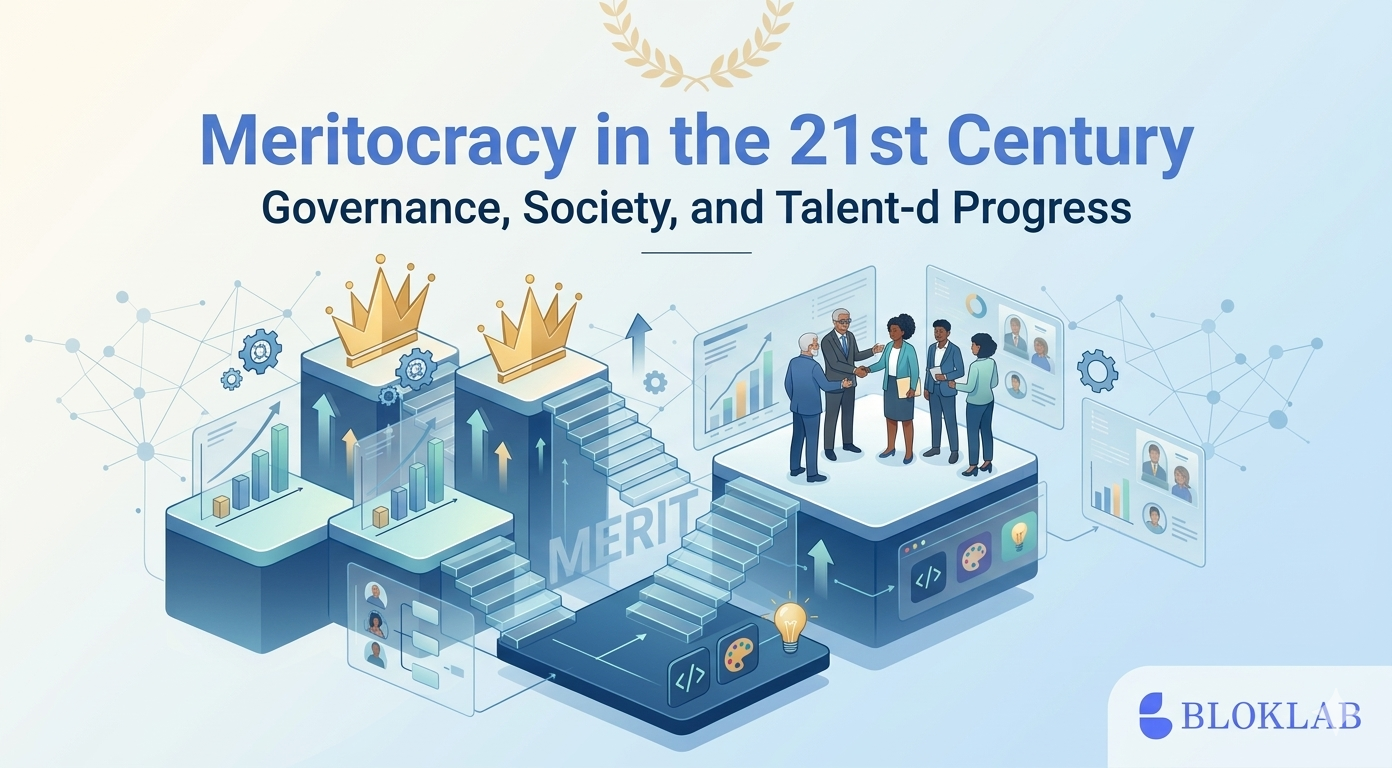
Meritocracy in the 21st Century: Governance, Society, and Talent-Based Progress
In a rapidly evolving global landscape, the mechanisms by which societies allocate power, responsibility, and opportunity are under increasing scrutiny. While democracy has long served as the predominant political framework, questions have arisen about its ability to consistently reward competence and long-term vision over popularity, charisma, or inherited privilege. Against this backdrop, meritocracy has emerged as both an ideal and a practical model for structuring leadership, institutions, and social mobility.
Meritocracy, in its most fundamental sense, is a system where advancement and authority are awarded based on ability, skill, and demonstrated achievement. Unlike traditional hierarchies driven by wealth, social status, or connections, meritocracy seeks to align societal rewards with tangible competence. Its application extends beyond governance into corporate leadership, education, and even civic participation, influencing how individuals, organizations, and states define “excellence” and “responsibility.”
Historical and Theoretical Foundations
The term “meritocracy” was first coined by sociologist Michael Young in his 1958 work The Rise of the Meritocracy, intended as a cautionary tale. Young imagined a society in which intelligence and effort determined social ranking, highlighting the risk that rigid merit-based hierarchies could entrench new forms of inequality. Nevertheless, meritocracy as a principle has endured because it addresses a perennial problem: how to balance fairness, efficiency, and competence in complex societies.
Historically, meritocratic ideas trace back further:
Imperial China: Civil service exams selected government officials based on scholarly ability rather than noble birth.
Enlightenment Europe: Philosophers such as Voltaire and Rousseau emphasized rational merit over hereditary privilege in political and educational systems.
Modern Corporate Structures: Contemporary organizations increasingly rely on performance metrics, skill assessments, and evidence-based promotion criteria, echoing meritocratic principles.
The theoretical challenge has always been twofold: designing objective measures of competence and ensuring that structural inequities do not undermine fair access to opportunities.
Core Principles of Meritocracy
A robust meritocratic system rests on several interdependent principles:
Objective Evaluation: Promotions and rewards are based on clear, measurable performance metrics. These may include educational attainment, professional achievements, innovative contributions, or demonstrable leadership skills.
Equal Access: All individuals must have equitable opportunities to demonstrate their abilities. This includes access to education, mentorship, and professional resources.
Accountability and Transparency: Leaders and decision-makers are evaluated regularly, and outcomes—whether promotions, funding allocations, or public policy—are documented and visible.
Continuous Learning: Meritocracy values growth. Advancement is contingent not only on past performance but also on ongoing skill development and adaptation to new challenges.
These principles collectively ensure that meritocracy is not merely an abstract ideal but a functional framework capable of guiding social and institutional behavior.
Advantages of Meritocratic Systems
Meritocracy offers distinct advantages for governance and organizational design:
Enhanced Efficiency: Assigning responsibilities based on competence increases the likelihood that tasks are executed effectively and decisions are well-informed.
Innovation Incentives: Systems that reward skill and creativity foster an environment where experimentation and novel solutions are encouraged.
Social Motivation: Individuals are incentivized to develop abilities and pursue excellence, knowing that achievement—not status or connections—determines opportunity.
Long-Term Planning: Competence-driven governance prioritizes sustainable strategies over short-term popularity or electoral gain.
These advantages, however, are contingent upon rigorous implementation and ongoing oversight.
Challenges and Critiques
No system is without limitations. Meritocracy faces several inherent challenges:
Measurement Complexity: Skills, intelligence, and leadership capacity are multidimensional and context-dependent. Simplistic metrics risk misrepresenting true ability.
Social Inequalities: Access to resources such as quality education, professional networks, or technological tools can skew meritocratic outcomes, inadvertently reproducing privilege.
Perceived Legitimacy: Societal buy-in is crucial. If individuals perceive evaluations as biased or opaque, the system risks losing credibility.
Overemphasis on Individual Achievement: Excessive focus on measurable results may undervalue teamwork, social cohesion, and ethical considerations.
Addressing these concerns requires both structural safeguards and cultural norms that emphasize fairness, inclusivity, and accountability.
Contemporary Applications
Meritocracy manifests in multiple domains today:
1. Governance
Countries like Singapore and Finland have integrated meritocratic principles into civil service recruitment and political advisory structures. Officials are selected through rigorous evaluation processes that weigh expertise and demonstrated competence alongside traditional political considerations.
2. Education
Universities increasingly use holistic admissions processes that balance academic performance, extracurricular achievements, and personal potential. Scholarship programs often target high-achieving students from diverse backgrounds, reflecting meritocratic ideals while attempting to mitigate structural inequities.
3. Corporate and Technological Leadership
Leading firms in the technology and finance sectors implement data-driven performance assessments, promotions based on demonstrable results, and leadership pipelines that emphasize skill development. Companies like Google and Tesla maintain internal systems to track measurable contributions and encourage innovation-driven meritocracy.
4. Civic and Digital Platforms
Emerging GovTech initiatives explore digital meritocracies where civic contributions—open-source problem-solving, community service, and innovation—can influence participatory decision-making. Blockchain-based credentialing, for example, could quantify and verify citizen skills in a transparent, auditable manner.
The Future of Meritocracy
As societies face increasingly complex problems—from climate change to technological disruption—systems that reward competence over convenience will be essential. Future meritocracies are likely to integrate:
Digital Credentialing: Verifiable proof of skills and achievements via blockchain or secure digital IDs.
AI-Supported Evaluations: Advanced analytics for assessing performance while minimizing bias.
Inclusive Access Programs: Targeted interventions to ensure equitable participation, particularly for historically marginalized groups.
Global Collaboration Networks: International merit-based partnerships that recognize talent and expertise across borders.
In this vision, meritocracy is not merely a method of ranking individuals but a societal framework that aligns incentives, fosters accountability, and encourages lifelong learning.
Conclusion
Meritocracy, when thoughtfully implemented, can create a society in which talent, effort, and achievement shape opportunity and influence. It encourages innovation, efficiency, and fairness while presenting measurable frameworks for evaluating leadership and contribution. Yet, it also demands vigilance against structural inequities and the oversimplification of human capability.
As the 21st century progresses, meritocratic principles—integrated with technological innovation, inclusive policy design, and ethical oversight—may provide the foundation for more capable, equitable, and forward-looking societies.