Bloklab Blog
Top 20 AI Agent Use Cases Transforming Industries
Published on 3/16/2026
Discover the top 20 real-world use cases of AI agents and how autonomous systems are reshaping business operations, productivity, and digital infrastructure.
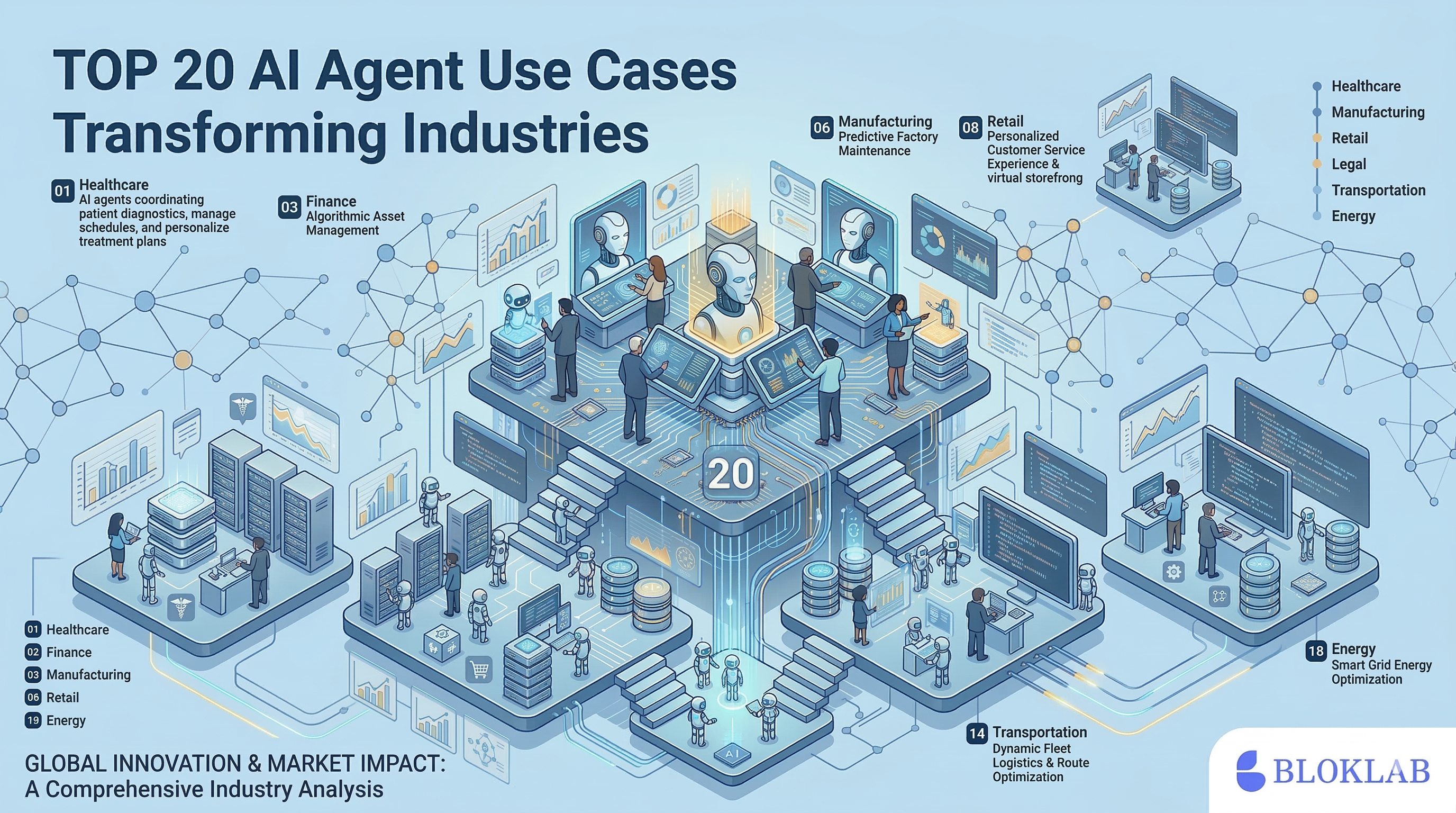
Top 20 AI Agent Use Cases Transforming Industries
Artificial intelligence is moving beyond chat interfaces and static automation toward autonomous systems capable of executing tasks and coordinating complex workflows. These systems, known as AI agents, can interact with tools, process large volumes of information, and operate across digital environments with minimal human supervision.
As the technology matures, AI agents are becoming increasingly relevant across industries—from software development and finance to healthcare and government services. Below are twenty of the most impactful and practical use cases for AI agents that are already emerging today.
1. Autonomous Software Development Agents
AI agents can assist software teams by autonomously generating code, debugging errors, writing tests, and deploying applications.
Instead of simply suggesting code snippets, these agents can manage entire development tasks such as:
implementing new features
fixing bugs
reviewing pull requests
optimizing performance
This significantly reduces development time while allowing engineers to focus on higher-level architecture and innovation.
2. Customer Support Agents
Many companies are deploying AI agents capable of managing large volumes of customer inquiries.
These agents can:
answer product questions
troubleshoot issues
process refunds
escalate complex cases
By integrating with CRM systems and knowledge bases, customer support agents can resolve a majority of requests automatically.
3. Personal Productivity Agents
Personal AI agents can manage everyday digital tasks for individuals.
Examples include:
organizing emails
scheduling meetings
summarizing documents
preparing daily briefings
These agents function as digital assistants capable of proactively managing workflows.
4. Financial Analysis Agents
AI agents can analyze financial data, detect patterns, and generate reports.
They are increasingly used for:
investment research
portfolio optimization
risk analysis
fraud detection
In financial institutions, such agents can process massive datasets far more quickly than traditional systems.
5. Autonomous Research Agents
Research agents can scan academic papers, datasets, and industry reports to identify relevant insights.
This can dramatically accelerate:
scientific discovery
market analysis
policy research
competitive intelligence
Instead of manually reviewing hundreds of documents, researchers can rely on agents to produce structured summaries and insights.
6. Marketing Campaign Agents
AI agents can design and execute marketing campaigns by analyzing audience behavior and optimizing advertising strategies.
Tasks may include:
generating marketing content
testing advertising variations
adjusting budgets in real time
tracking campaign performance
This enables highly adaptive marketing strategies.
7. Sales Pipeline Agents
Sales teams can deploy agents that automatically manage leads and optimize outreach strategies.
These systems can:
qualify leads
personalize outreach emails
track customer engagement
schedule follow-up meetings
This helps organizations scale sales operations efficiently.
8. Cybersecurity Monitoring Agents
AI agents can monitor network activity and identify potential security threats.
They can detect:
unusual login behavior
malware patterns
unauthorized data access
suspicious financial transactions
Early detection allows organizations to respond to threats much faster.
9. Supply Chain Optimization Agents
Global supply chains are extremely complex systems.
AI agents can help by:
forecasting demand
optimizing logistics routes
managing inventory levels
predicting supplier disruptions
This improves operational efficiency and reduces costs.
10. Healthcare Diagnosis Support Agents
AI agents can assist medical professionals by analyzing patient records and medical data.
Potential applications include:
identifying disease patterns
suggesting diagnostic tests
recommending treatment options
These systems act as decision-support tools rather than replacements for physicians.
11. Legal Research Agents
Legal professionals spend significant time reviewing case law and regulatory documents.
AI agents can analyze large legal databases and quickly identify:
relevant precedents
regulatory requirements
contract risks
This allows lawyers to focus on strategic legal reasoning.
12. Education and Learning Agents
AI agents can function as personalized tutors.
They can:
adapt lessons to a student’s learning pace
generate quizzes and exercises
explain complex topics in different ways
Such systems could significantly improve accessibility to quality education.
13. Content Creation Agents
Media companies and creators increasingly rely on AI agents to support content production.
Agents can assist with:
research
script writing
video editing workflows
publishing schedules
These tools accelerate creative processes.
14. HR Recruitment Agents
Recruitment agents can automate candidate screening and evaluation.
They can analyze:
resumes
skill assessments
work experience
cultural fit indicators
This helps organizations identify promising candidates more efficiently.
15. Smart City Infrastructure Agents
Urban infrastructure generates massive amounts of data.
AI agents can help manage:
traffic flows
public transportation optimization
energy consumption
environmental monitoring
These systems contribute to more efficient and sustainable cities.
16. Climate and Environmental Monitoring Agents
AI agents can analyze satellite data and environmental sensors to track climate patterns.
They can monitor:
deforestation
air pollution
carbon emissions
ocean temperatures
Such insights are critical for climate policy and sustainability efforts.
17. GovTech Administrative Agents
Governments can deploy AI agents to streamline public services.
Applications may include:
permit processing
document verification
public service inquiries
tax assistance
These systems can significantly reduce administrative workloads.
18. E-commerce Operations Agents
Online retailers use AI agents to optimize operations.
Agents can manage:
pricing strategies
product recommendations
inventory management
fraud detection
This improves both operational efficiency and customer experience.
19. Travel Planning Agents
Travel agents powered by AI can plan complete itineraries based on user preferences.
They can:
search flights and hotels
compare prices
generate travel schedules
handle bookings
This turns travel planning into a fully automated process.
20. Autonomous Business Operations Agents
Perhaps the most ambitious application involves agents managing entire business workflows.
Such agents could coordinate:
accounting
marketing
operations
analytics
In the future, small companies may run significant parts of their operations through networks of specialized AI agents.
Conclusion
AI agents are quickly becoming one of the most transformative technologies in the digital economy. By combining reasoning, planning, and tool usage, these systems move beyond simple automation toward autonomous problem-solving across complex workflows.
As infrastructure improves and new architectures emerge, AI agents are likely to become standard components in software platforms, enterprise systems, and even personal digital environments.
Organizations that understand how to design, deploy, and manage agent-based systems today will be far better positioned to thrive in the increasingly automated economy of tomorrow.