Bloklab Blogi
AI, LLMs, and LAMs: A Unified Architecture for Intelligent Systems
Julkaistu: 3/18/2026
Discover the top 20 real-world use cases of AI agents and how autonomous systems are reshaping business operations, productivity, and digital infrastructure.
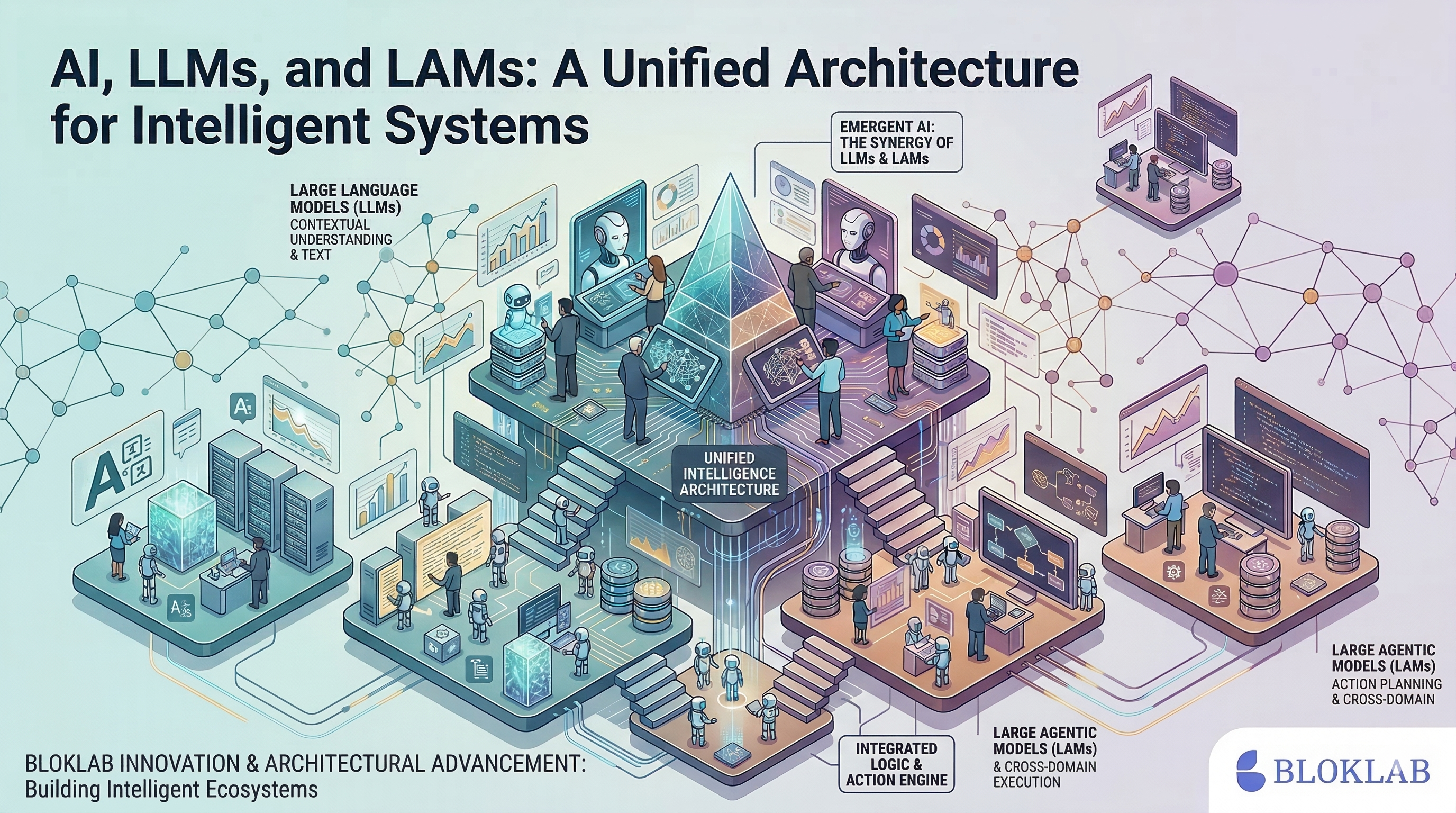
From Language Understanding to Autonomous Action
Artificial intelligence is no longer a single paradigm. Over the past few years, it has evolved into a layered ecosystem of capabilities—ranging from predictive models to generative systems and now to action-oriented agents.
Three terms increasingly define this landscape:
AI (Artificial Intelligence) – the broad discipline
LLMs (Large Language Models) – systems that understand and generate language
LAMs (Large Action Models) – emerging systems designed to execute tasks
Understanding how these components differ—and more importantly, how they integrate—is essential for building modern intelligent applications.
1. AI as the Foundation Layer
Artificial Intelligence refers to the broader field of building machines capable of performing tasks that typically require human intelligence.
This includes:
machine learning
computer vision
natural language processing
robotics
optimization systems
AI is not a single technology but a stack of methodologies. LLMs and LAMs are specialized evolutions within this broader ecosystem.
Think of AI as the infrastructure layer, upon which more specialized capabilities are built.
2. LLMs: The Reasoning and Language Layer
Large Language Models represent a major breakthrough in how machines process and generate human language.
They are trained on vast amounts of text data and can:
generate human-like responses
summarize complex information
write code
translate languages
perform reasoning tasks
However, LLMs have important limitations:
they do not inherently access real-time data
they cannot reliably execute actions
they may hallucinate incorrect information
they are bounded by their training data
In essence, LLMs are exceptional reasoning engines, but they are not inherently connected to the external world.
3. LAMs: The Action Layer
Large Action Models (LAMs) are an emerging concept that extends beyond language understanding into execution.
While LLMs answer questions, LAMs aim to:
perform tasks
interact with software systems
automate workflows
make decisions based on goals
LAMs are often implemented as AI agents that combine:
reasoning (via LLMs)
tool usage (APIs, databases)
planning systems
feedback loops
In this sense, LAMs are not entirely separate from LLMs—they are systems built on top of them, adding action and autonomy.
4. Key Differences: AI vs LLM vs LAM
LayerCore FunctionCapabilityLimitationAIBroad intelligencePattern recognition, predictionFragmented systemsLLMLanguage & reasoningText generation, analysisNo real-world actionLAMAction & executionTask automation, workflowsComplexity, reliability
This layered model helps clarify how modern systems are structured.
5. Bridging the Gap: RAG (Retrieval-Augmented Generation)
One of the most important innovations in modern AI systems is Retrieval-Augmented Generation (RAG).
RAG enhances LLMs by connecting them to external data sources.
Instead of relying solely on training data, the system:
retrieves relevant information from a database
injects it into the prompt
generates a response grounded in real data
Why RAG Matters
reduces hallucinations
enables real-time knowledge
supports enterprise use cases
improves factual accuracy
RAG is widely used in:
internal knowledge assistants
legal document search
customer support systems
research tools
It effectively turns LLMs into context-aware systems.
6. Beyond RAG: Advanced Architectures
While RAG is foundational, modern AI systems increasingly combine multiple techniques.
a. Tool-Using LLMs
LLMs can be extended with tools such as:
calculators
APIs
code interpreters
databases
This allows them to:
fetch live data
perform computations
trigger workflows
b. Agent-Based Systems
Agents represent the evolution from static models to dynamic systems.
They can:
plan multi-step tasks
execute actions
iterate based on feedback
Agents are the practical realization of LAM concepts.
c. Memory-Augmented Systems
Memory systems allow AI to:
retain user context
learn from past interactions
personalize outputs
This is critical for long-running workflows.
d. Multi-Agent Architectures
Instead of a single system, multiple agents collaborate:
research agent
execution agent
validation agent
This improves scalability and specialization.
e. Fine-Tuning and Domain Adaptation
Organizations adapt models to specific domains:
healthcare
finance
legal
govtech
Fine-tuning ensures higher accuracy and compliance.
7. How These Systems Work Together
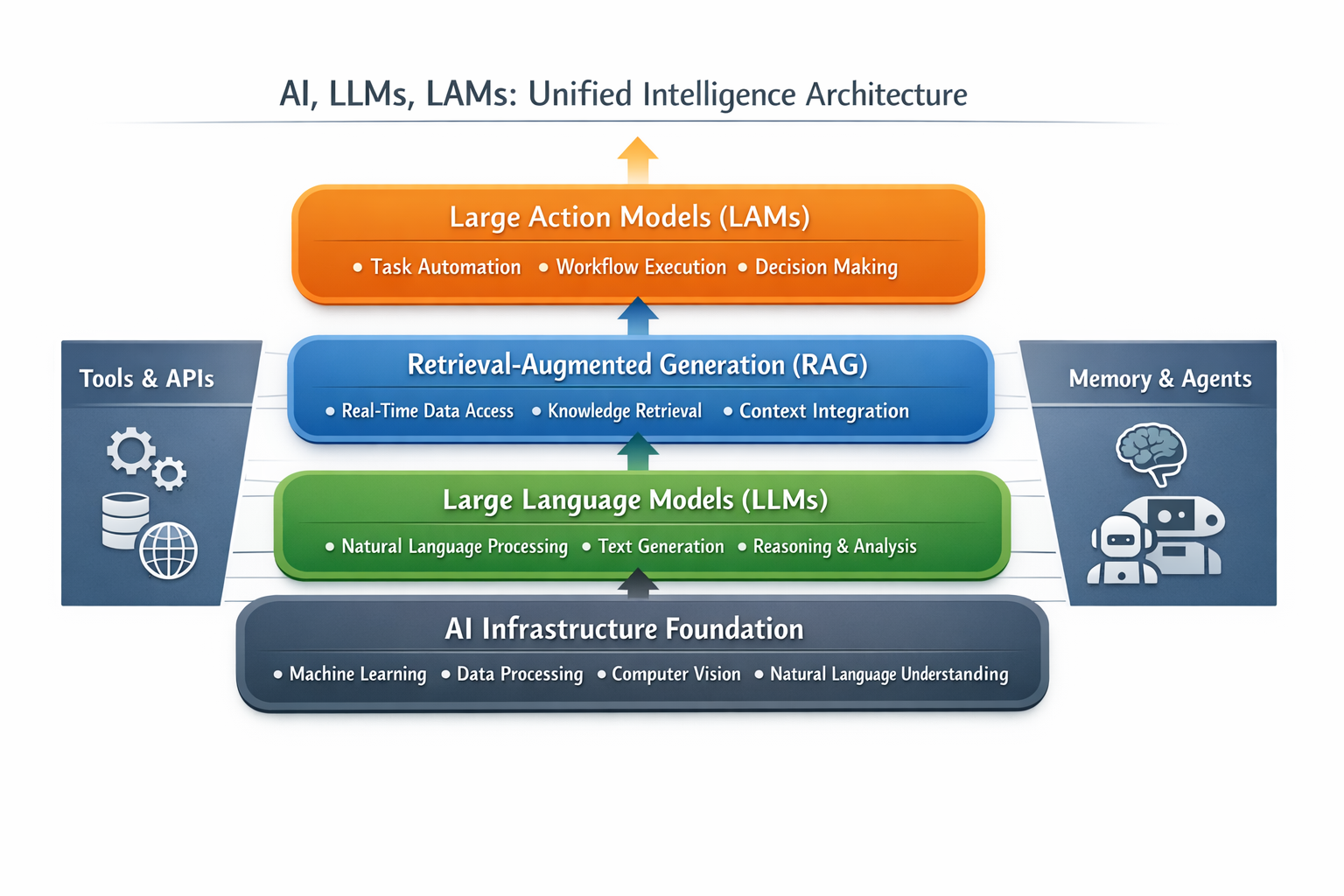
Modern intelligent systems are not built using a single component. Instead, they combine multiple layers:
Example: Smart GovTech Platform
LLM Layer
Interprets citizen queriesRAG Layer
Retrieves policy documents and regulationsAgent Layer (LAM)
Executes actions such as:submitting applications
verifying identity
processing requests
AI Infrastructure
Handles data processing, analytics, and optimization
This layered approach enables systems that are:
intelligent
reliable
actionable
8. Real-World Use Case Stack
Example: Enterprise Knowledge Assistant
RAG → retrieves company documents
LLM → summarizes and answers questions
Agent → triggers workflows (e.g., create report, send email)
Example: Carbon Footprint App
AI → calculates emissions
LLM → explains impact to users
Agent → rewards behavior or updates systems
Example: Digital Identity Platform
LLM → verifies documents and explains processes
RAG → accesses government records
Agent → issues credentials or approvals
9. Challenges in Modern AI Architectures
Despite rapid progress, several challenges remain:
Reliability
Multi-step systems can fail at different stages.
Latency
Combining retrieval, reasoning, and action increases response time.
Security
Agents interacting with systems introduce new attack surfaces.
Alignment
Ensuring correct decision-making is still an open problem.
10. The Future: From Intelligence to Autonomy
We are moving toward a world where AI systems are no longer passive tools but active participants in digital environments.
Future systems will likely include:
fully autonomous business agents
personal AI operators
decentralized AI networks
real-time adaptive systems
The convergence of AI, LLMs, and LAMs will define the next generation of software—where systems not only understand the world but also act within it.
Conclusion
AI is evolving into a layered architecture:
AI provides the foundation
LLMs provide reasoning and language
LAMs enable action and execution
Technologies like RAG, agents, memory systems, and tool integration are bridging the gaps between these layers, creating systems that are not only intelligent but also operational.
Organizations that understand how to combine these components effectively will lead the next wave of digital innovation.