Bloklab Blog
Quantum Computing Education and Access in Finland
Published on 4/2/2026
Finland is quietly emerging as one of Europe’s most advanced hubs for quantum computing—offering students and researchers direct access to real quantum hardware, world-class research infrastructure, and a rapidly growing innovation ecosystem.
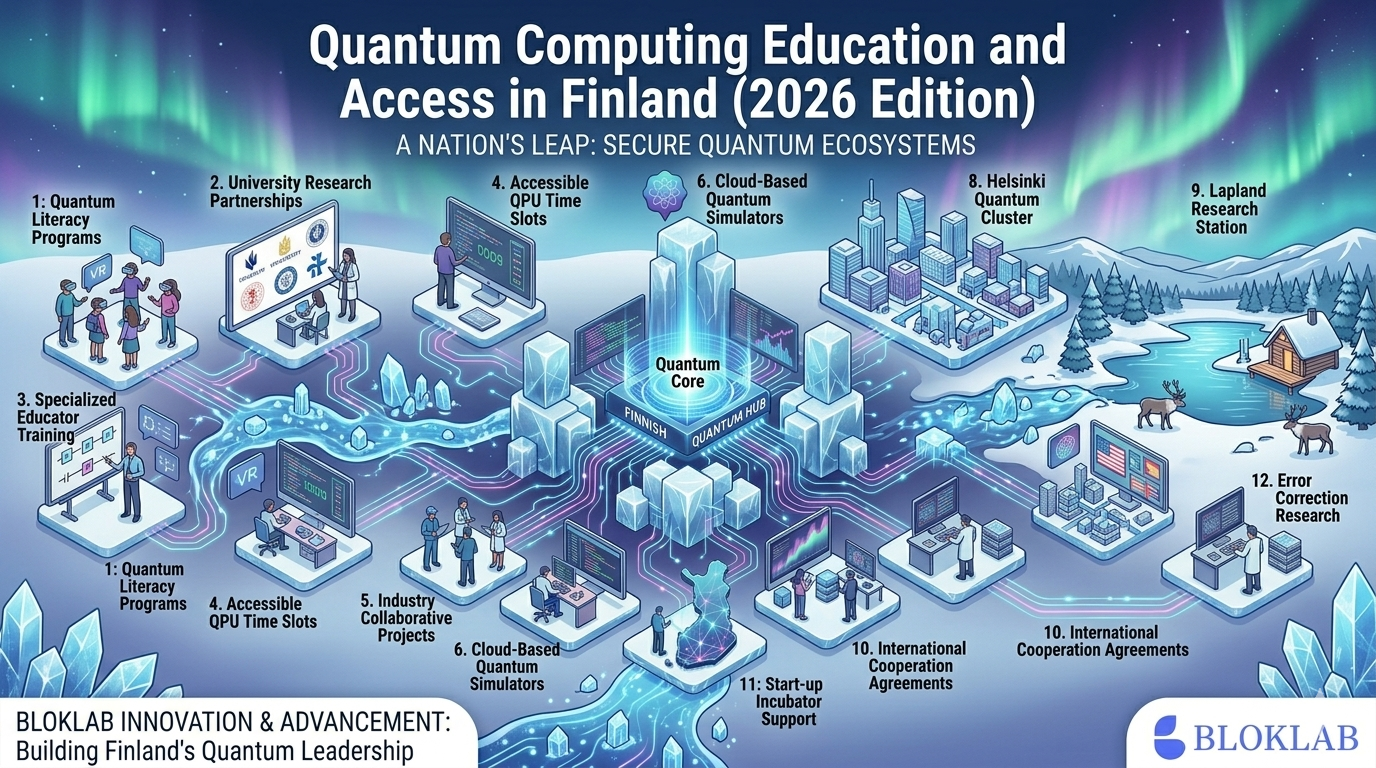
Quantum Computing Education and Access in Finland
Building Europe’s Next Quantum Talent Hub
Finland is positioning itself at the forefront of the quantum revolution—not just through research breakthroughs, but by democratizing access to quantum computing infrastructure.
Unlike many countries where quantum systems remain confined to isolated labs, Finland has taken a more open and strategic approach: integrating real quantum computers into university environments, enabling students and researchers to work directly with cutting-edge hardware.
Real Quantum Computers in Universities
One of the most significant developments in Finland’s quantum ecosystem is the deployment of superconducting quantum computers developed by IQM Quantum Computers.
A flagship example is the Aalto Q20, a 20-qubit quantum computer installed at Aalto University. This system is not a theoretical or simulated environment—it is a fully operational quantum processor accessible to researchers and, in structured programs, to students.
This level of access is rare globally. It allows learners to:
Run real quantum circuits
Experiment with noise and decoherence
Develop and test quantum algorithms
Understand hardware-level constraints
In essence, students are not just learning about quantum computing—they are actively building within it.
A National Ecosystem for Quantum Learning
Finland’s strength lies not only in hardware access but in its coordinated national infrastructure.
Key institutions include:
Aalto University – leading quantum education and research
VTT Technical Research Centre of Finland – applied quantum research and development
CSC – IT Center for Science – providing computational resources and access frameworks
Together, these institutions provide:
structured quantum education programs
access to quantum computing time
research collaborations
integration with classical high-performance computing (HPC)
This creates a full-stack learning environment, bridging theory, simulation, and real hardware.
Access Model: Not Personal, But Powerful
It is important to clarify what “access” means in the Finnish context.
Finland does not provide every student with a personal quantum computer. Instead, it offers:
shared access to real quantum systems
scheduled computation time
educational frameworks and courses
research project integration
This model is similar to how early supercomputers were accessed—centralized, but highly impactful.
What This Means for Students and Researchers
For students, this ecosystem unlocks opportunities that are still inaccessible in many parts of the world:
1. Practical Quantum Skills
Students gain hands-on experience with:
quantum programming
algorithm design
hardware-aware optimization
2. Research Readiness
Direct access to real systems prepares students for:
PhD-level research
industry R&D roles
deep tech innovation
3. Industry Alignment
With companies like IQM Quantum Computers actively collaborating with universities, the gap between academia and industry is significantly reduced.
Strategic Importance: Finland as a Quantum Leader
Finland’s approach reflects a broader national strategy:
invest in deep tech infrastructure
enable early talent development
build globally competitive expertise
By giving students access to real quantum systems, Finland is effectively:
compressing the learning curve of an entire generation of engineers and researchers
This creates a long-term competitive advantage in:
quantum computing
cryptography
optimization
materials science
The Bigger Picture: Democratizing Deep Tech
Globally, access to frontier technologies often defines who leads the next wave of innovation.
Finland’s model suggests a powerful alternative:
open access (within structured systems)
public-private collaboration
education tightly integrated with infrastructure
This is not just about quantum computing.
It is about how nations build future-ready talent ecosystems.
Conclusion
Finland is not simply investing in quantum technology—it is investing in people who can build the quantum future.
By embedding real quantum computers into universities and making them accessible to students and researchers, the country is creating a practical, scalable, and forward-looking education model.
As the global race for quantum leadership accelerates, Finland’s approach may well become a blueprint for others to follow.